
You are here: Home › Water management
Signs it is time to act
- Puddles that take more than 24 hours to disappear.
- A damp basement, a weeping foundation wall, a musty smell.
- Spongy grass, or grass that always yellows in the same spot.
- Erosion channels, always along the same path.
- Ice building up in the same corner every winter. That is not bad luck, that is drainage.
One detail helps tell them apart: a surface problem shows up outside and dries out between rains. A foundation drain problem shows up inside, as white powder on the concrete or constant damp, and it persists regardless of recent weather.
New: the Quebec government helps you protect your home against flooding
Water in the basement every spring? A yard that turns into a pool with every heavy rain? Quebec just put 425 million dollars on the table to help you fix it. The flooding component of the Rénoclimat program starts October 1, 2026.
Battery-backed sump pump, backwater valve or removable flood barriers. Open to every house, even outside a flood zone. This is the easiest component to get.
A risk assessment done by an accredited professional. That report is what decides whether you qualify for component 3.
Foundation protection, sealing of doors and windows, electrical system adaptation, raising the building. Reserved for houses in an officially recognized flood zone.
We do the work
French drains, dry wells, grade correction, leveling, excavation around foundations: this has been our bread and butter for years in Laval and Greater Montreal. We build your quote line by line from your assessment's recommendations, so your file goes through the first time.
Rénoclimat program, Climate hazards adaptation component, Government of Quebec. Altitude Services is not affiliated with the government and does not guarantee approval. Subject to eligibility.
Start with the cheapest fix: your gutters
A downspout emptying at the base of the foundation sends hundreds of gallons straight against your basement wall with every heavy rain. In Laval it is not even a matter of choice: bylaw L-11870 requires roof water to be discharged onto a permeable surface at least one metre from the building, and forbids connecting it to the foundation drain.
It is often the only correction needed, and the cheapest. We will tell you that before selling you anything else.
The grade around the foundation
The ground should fall away from the wall. The Quebec Construction Code requires at least 2 %, but the APCHQ recommends closer to 10 % over the first six feet, because backfill settles over the years and eventually creates a reverse slope. In practice that means about 7 inches of drop over the first six feet.
Houses built before the 1990s have gentler grades than current codes require. If you own a 1960s or 70s bungalow in Laval, there is a good chance that is your problem.
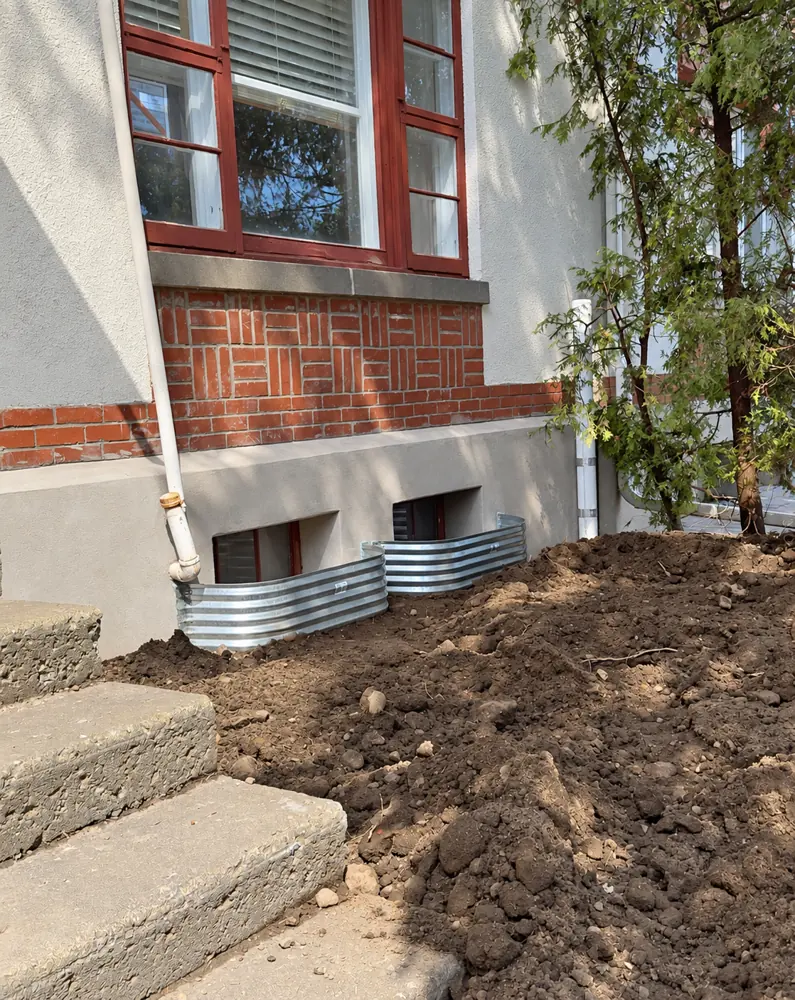
New parging and a window well to raise the grade
We redid the parging on the foundation and installed a window well around the basement window. That lets us bring the ground up and build a real slope that sends water away from the house.
Have my grade checkedFrench drain or dry well
They are not the same thing and the choice is not random.
The French drain
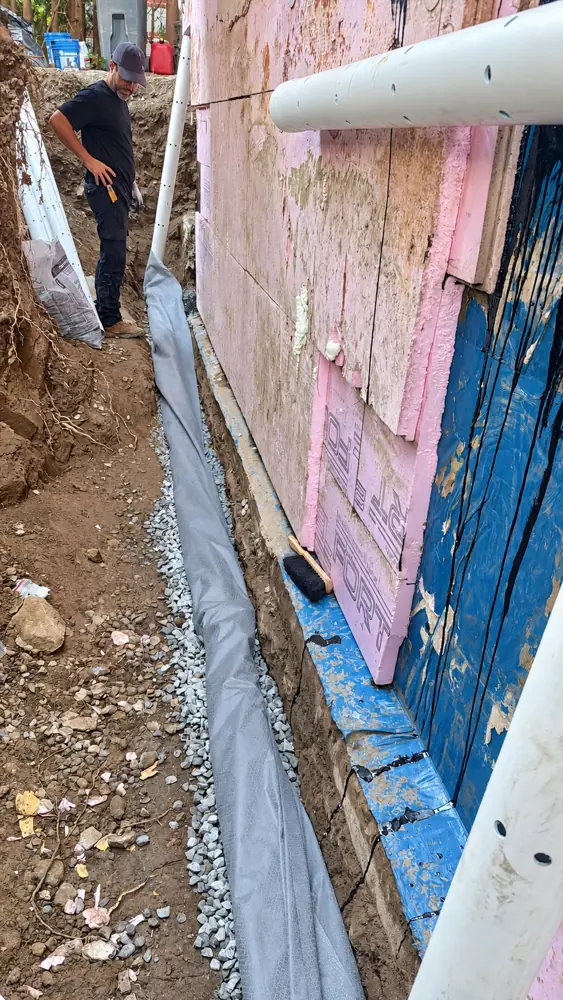
It captures water and carries it elsewhere, so it needs a lower outlet: the street, a ditch, ground that falls away. A trench, clean stone, a 4 inch perforated drain sloped at least 2 %, geotextile, and a real daylight outlet. The geotextile is the part others skip: without it, soil fines clog the stone within a few years and the drain stops draining with nothing showing on the surface.
The dry well
It receives water and lets it soak in on site. That is the answer when there is no outlet. One caution: on clay soil, a dry well without an outlet can be money thrown away. We run a percolation test before recommending it, not after.
On many properties the right answer is both together: capture, carry, then infiltrate away from the house.
A French drain, for real


Our drainage work is guaranteed in writing
If the water comes back, we come back. It is written in the quote, not said out loud. $2,000,000 civil liability insurance.
Where we travel
Laval and all its districts, the Lower Laurentians, Deux-Montagnes and Lanaudière. Your town not on the list? Call anyway, we often travel a bit farther for a good project.
Frequently asked questions
What does a French drain cost?
It depends on the length, the depth, the soil type and where the water can go. Our online estimator gives a ballpark, but two properties that look alike can need completely different work. We come out, we look, and we give you a firm written price. The visit is free.
Can I solve it by sending the water onto my neighbour's land?
No. The Civil Code of Québec provides that lower land must receive water flowing naturally from higher land, but that the owner of the higher land cannot make the situation worse. A fix that pushes your water onto the neighbour is a dispute waiting to happen. We direct water to the street, a ditch, or a well on your own property.
Is my foundation drain finished?
A foundation drain lasts 20 to 30 years. Before digging, the right move is a camera inspection through the cleanout or the sump, to find out whether it is blocked, crushed or simply done. Digging right away can mean spending $15,000 on what was a $2,000 surface problem.
What time of year do you work?
Drainage corrections run from thaw until the fall freeze. November is often the last call. In winter we take quotes and plan the spring.